Maybe the aliens are using gamma rays
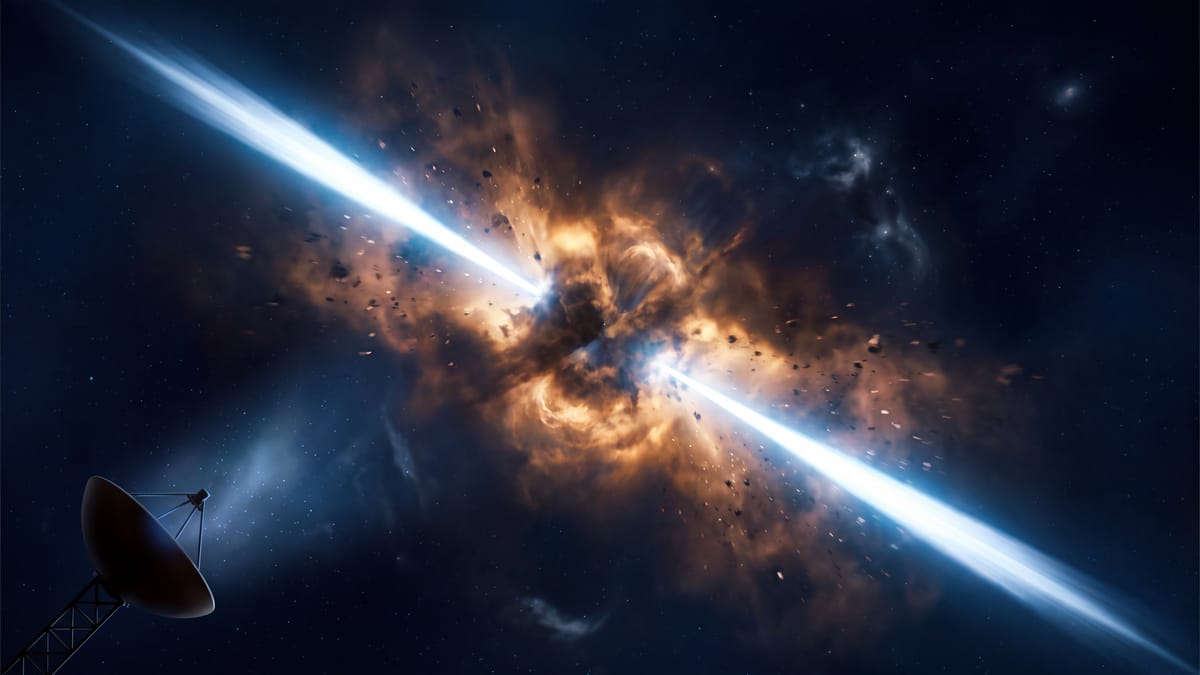
A very energetic idea
I've been thinking about interstellar communication, which is an odd thing to do when there are perfectly good nearer-term problems available.
The speed of light is a hard limit. Send a message to a civilisation ten light-years away and it arrives ten years later. If they answer straight away, the reply lands twenty years after you asked. There's no clever conversational rhythm to this. You send your message and then get on with your life for a couple of decades.
So if you only get one shot at saying something, you want to pack as much information into the signal as possible.
My first thought was: higher frequency means more energy per photon. Gamma rays are conventionally the highest-energy part of the electromagnetic spectrum. Therefore, perhaps advanced civilisations communicate in gamma rays. Perhaps the gamma-ray bursts we see aren't merely astronomical explosions. Perhaps they're messages.
The appeal of gamma rays
Gamma rays aren't just light with a more intimidating name. A gamma-ray photon can carry vastly more energy than a radio photon. If you're trying to get a signal across interstellar space, that sounds useful. Perhaps one extremely energetic photon could be easier for the receiver to notice than many lower-energy photons, with the actual message carried by its timing, energy or polarisation.
Gamma rays also have a certain dramatic plausibility. They're produced by the most violent things in the universe: collapsing stars, merging neutron stars, and matter falling into black holes. An advanced civilisation with access to stellar-scale energy might be able to create them deliberately. If you want to announce that you exist, it's hard to imagine a more extravagant way of doing it. It would also be a very loud way of saying nothing in particular.
And gamma-ray bursts really are focused. They aren't usually spherical explosions sending equal radiation in every direction. In the leading models, a burst launches narrow, relativistic jets. The jet travels close to the speed of light, and relativistic beaming concentrates much of the radiation into a small angle, which is why the brightest bursts are the ones we happen to see down the barrel. It's an extraordinary natural lighthouse. The picture is messier than a searchlight: GRB 170817A was an off-axis event we caught only because it was the nearest merger we've ever had, and some jets have structure rather than a clean edge. The beam is real either way.
Energy is not information
The first problem is that I've quietly confused energy with information.
A high-frequency photon carries more energy, not more information. Information lives in changes - the timing of a pulse, its intensity, its polarisation, the arrangement of a sequence - and none of that arrives free with a bigger energy bill. A single gamma-ray photon can be detected, but there isn't an infinite amount to say about it merely because it arrived with a lot of energy.
The useful quantity is closer to bandwidth and signal-to-noise ratio than to the frequency printed on the receiver. Shannon's famous result gives the capacity of a noisy channel in terms of its bandwidth and its signal-to-noise ratio. The carrier frequency matters because it affects the equipment, the propagation and the noise. It isn't, by itself, a magic information multiplier. You still need enough photons, with enough contrast against the background, for the receiver to rebuild what was sent - and a single very energetic photon is not a free megabyte.
A high carrier does bring two real advantages, and neither of them is about the photon.
The first is the ceiling on bandwidth. You can't modulate a carrier faster than it oscillates, so the carrier sets the roof: roughly a tenth of it, which is about a hundred megahertz around a gigahertz signal and tens of terahertz around an optical one. No single channel comes close - optical modulators run at tens of gigahertz - but the spectrum scales the same way, and optical links already span more than ten terahertz by running many slower channels side by side.
The second is gain per metre of aperture. A diffraction-limited beam narrows as the wavelength shortens, so at the same dish or mirror diameter a higher frequency concentrates more power on the target. A near-infrared laser and a three-centimetre-wavelength radio link of equal aperture differ by a factor of a few hundred million in received power. NASA describes its own optical terminal on the Psyche mission in the same terms: near-infrared light packs the data into significantly tighter waves than radio, so a ground station receives more data at once - at the price of pointing and tracking that has to be incredibly accurate.
Both are engineering consequences of the wavelength rather than information carried by the photon - and both presume a transmitter you can point and focus, which is exactly what gamma rays will not give you.
Expensive, and hard to aim
Gamma-ray photons are energetic because they're expensive. A transmitter capable of sending a detectable, tightly controlled gamma-ray message across light-years would need to put a great deal of energy into the beam.
That isn't an absolute bar. A very large aperture and a very patient receiver could bring the requirement down, and a narrower beam helps too. But radio and optical systems are, for us, far cheaper to build, cool, feed and point at the required performance. That's a practical engineering judgement rather than a theorem. The point is that the gamma option has to earn its keep against cheaper hardware, and the burden of explanation sits with whoever designed it. Expensive is not the same as better.
There are reasons to pay the bill. A gamma flash crosses a noisy local environment that would drown an optical link, and a burst that bright is hard to miss once you're in the beam. A civilisation might also simply be showing off, which isn't a technical explanation but is a very human one. None of that is a reason the data supports.
Then there's the aiming. A radio telescope can use a dish; an optical transmitter can use mirrors and lenses. At gamma-ray energies, ordinary mirrors and lenses don't behave like convenient glass: gamma rays pass through, scatter, or trigger particle interactions rather than bouncing neatly off a polished surface. NASA puts it plainly - unlike optical light and X-rays, gamma rays cannot be captured and reflected by mirrors. Focusing exists only at the edges of the band, and even there it is a laboratory instrument rather than a transmitter: grazing-incidence mirrors work for X-rays, and Laue crystal-diffraction lenses for the hard X-ray and soft gamma-ray region below about 1 MeV. At MeV energies and above there's no practical optic at all.
The narrowness of a gamma-ray burst comes mainly from the geometry and the relativistic speed of the jet that produced it. That's remarkable natural collimation, but it isn't the same as having a switchable, steerable, precisely modulated transmitter.
Space is not empty
The other problem is the journey.
Gamma rays don't travel through nothing. Getting here from another star means crossing dust, interstellar gas, the starlight of every galaxy in between, and the microwave background left over from the beginning of everything. A gamma ray can interact with any of it, but which partner matters depends steeply on the energy - the starlight and dust-reprocessed infrared bite hardest at TeV, the microwave background only above PeV.
Some gamma rays cross those distances anyway. Others are absorbed or scattered through processes such as pair production, in which a photon is converted into an electron and a positron in the presence of matter or another photon. At sufficiently high energies and over sufficiently long distances, the universe becomes less transparent: gamma rays from cosmological distances lose flux to pair production on the extragalactic background light, and the opacity grows with both energy and distance.
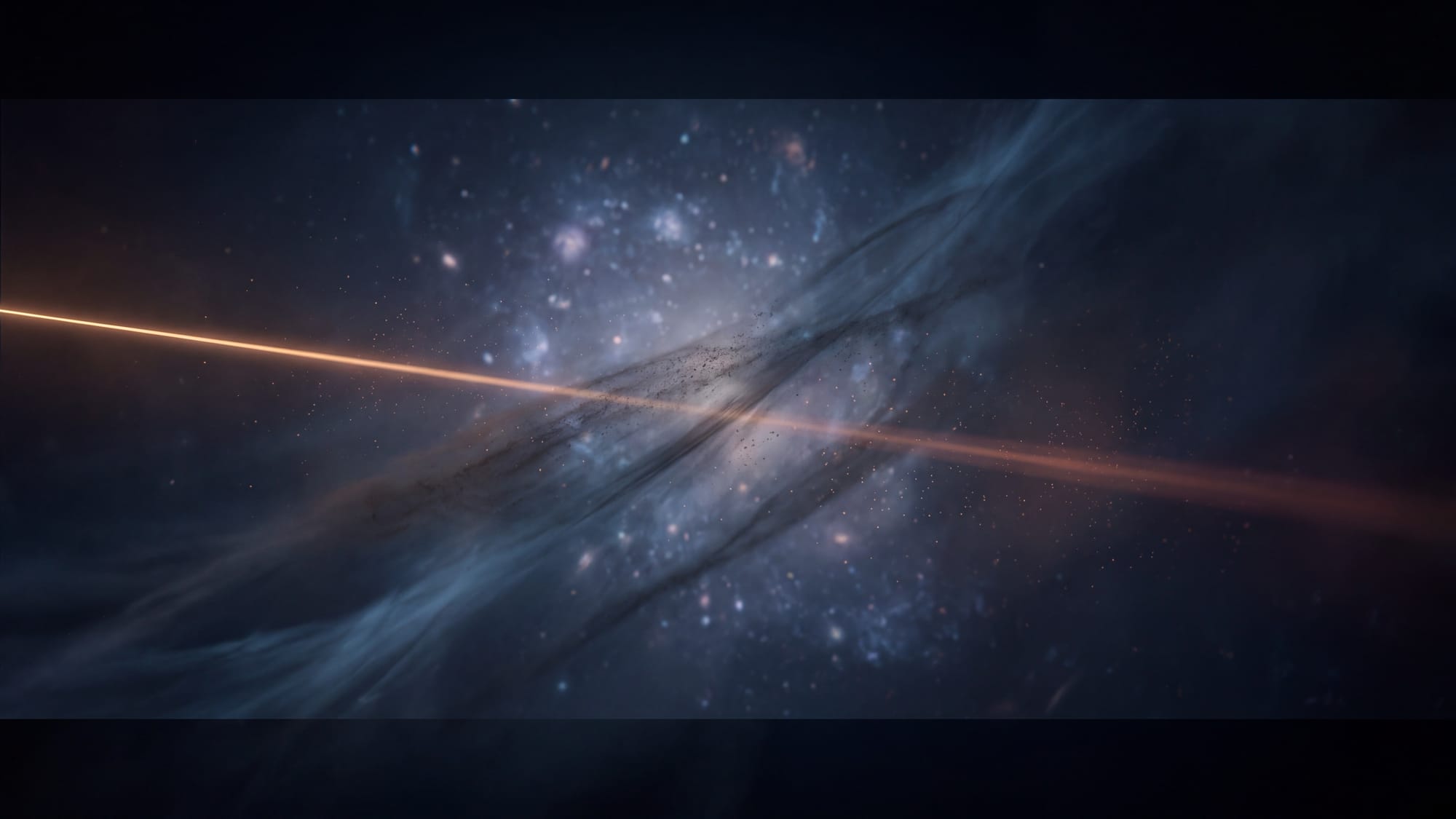
This isn't a simple "radio gets through and gamma rays don't" rule. Radio waves have their own absorption and scattering problems. Gamma rays can penetrate some materials that visible light cannot, and are stopped by others. The point is that choosing the highest possible frequency doesn't give you a straight, clean road between the stars.
What about gamma-ray bursts?
This leaves the entertaining version of the theory: perhaps GRBs are the signals themselves.
The trouble is that their known behaviour looks much more like an explosion than a transmission. Long gamma-ray bursts are most commonly associated with the collapse of massive stars; short bursts with compact-object mergers such as neutron-star collisions. Their flashes last from fractions of a second to minutes, with complicated variability produced by an extreme central engine. The split isn't perfectly clean: GRB 060614 ran for 102 seconds and showed no supernova at all, behaving more like a merger than a collapse, which is why the duration classes are a rule of thumb rather than a law.
The jets are aimed, but they aren't apparently aimed at somebody. Their direction is set by the angular momentum and physics of the event. That's an inference from models of how jets form, not a measurement of intent: nothing in the data records an aim, only an axis. The burst doesn't seem to contain a message encoded by an external intelligence. It's more like a cannon that happens to fire along its own spin axis.
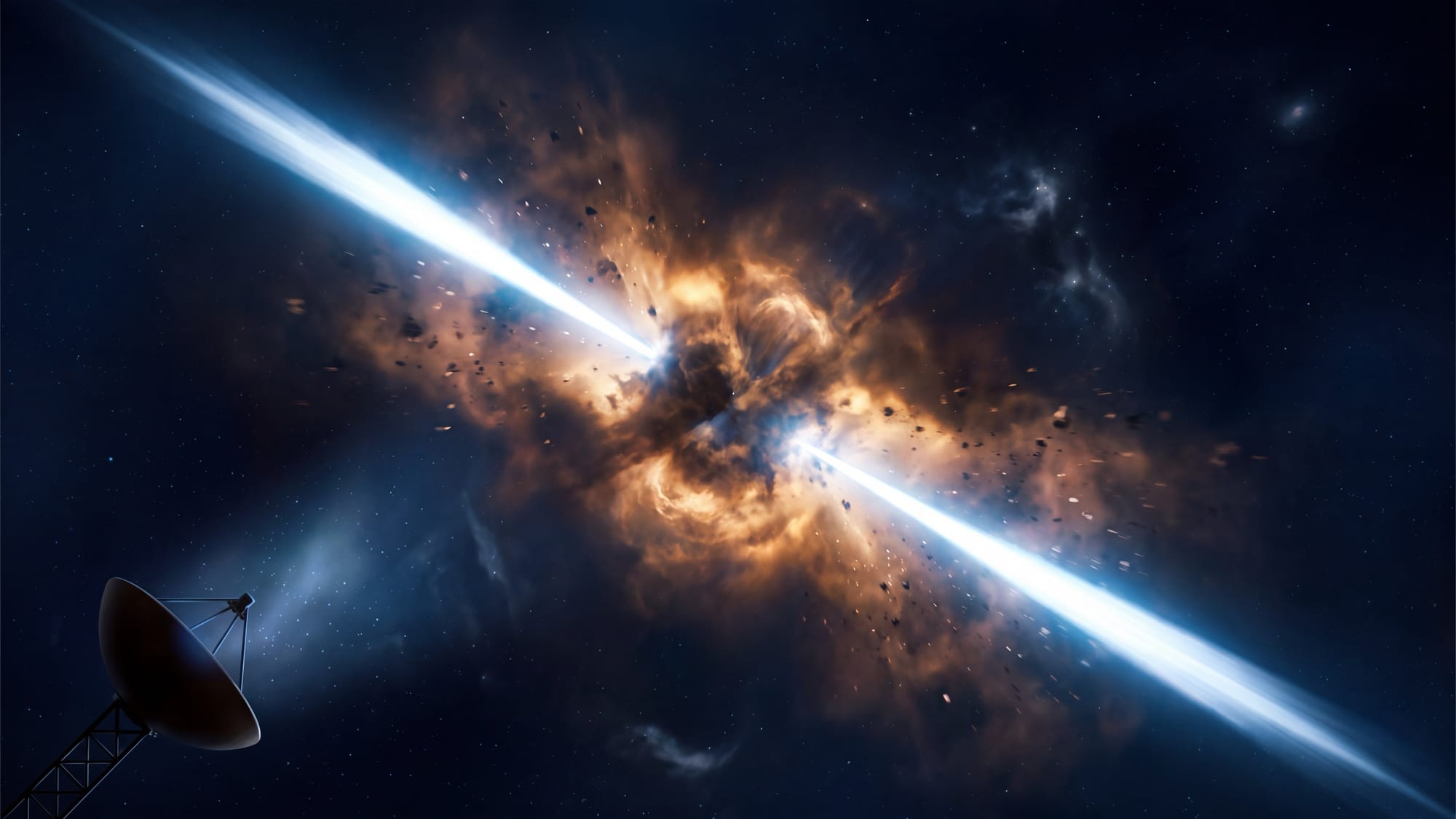
Could an advanced civilisation arrange a stellar explosion and use it as a beacon? Perhaps. But it would be an absurdly wasteful beacon, and the natural explanation currently accounts for the observations without requiring an artificial transmitter. A real message would be expected to show structure that's very difficult to produce accidentally: repeated patterns, a deliberate mathematical sequence, or modulation that survives a careful comparison with known burst physics.
The boring answer may be the good one
The best interstellar communication band may therefore be much less glamorous. Radio has low photon energy, but it's comparatively easy to generate, modulate, detect and steer. There's a famously quiet stretch of the spectrum, the water hole between the 21-centimetre hydrogen line and the 18-centimetre hydroxyl line - quiet in the sense of the interstellar noise floor, and a natural reference point for us and for anyone else out there. Parts of it are protected by regulation - the hydrogen line most strictly of all - but it isn't free of interference, much of it ours.
Optical and infrared lasers offer narrow beams and high bandwidth, though they bring their own pointing and detector problems.
The right choice depends on what the sender is trying to do. A civilisation trying to communicate cheaply may choose radio. A civilisation trying to send a lot of data through a narrow beam may choose optical or infrared. A civilisation trying to make one spectacular, unmistakable announcement might choose something stranger.
Gamma rays aren't impossible. They're just not the automatic answer produced by the phrase "maximum information". They trade manageable engineering for extreme energy, difficult beam control and a propagation environment that becomes less forgiving at high energies.
So perhaps gamma-ray bursts are messages from the stars. I wouldn't bet on it. They look like explosions because they probably are explosions.
References
- Claude E. Shannon, "A Mathematical Theory of Communication"
- NASA, "Gamma Rays" (electromagnetic spectrum)
- NASA, "Hubble Gamma-Ray Bursts"
- Salafia and Ghirlanda, "The Structure of Gamma Ray Burst Jets"
- Dwek and Krennrich, "The Extragalactic Background Light and the Gamma-ray Opacity of the Universe"
- "Hard X-ray/Soft gamma-ray Laue Lenses for High Energy Astrophysics"
- Gehrels et al., "A new gamma-ray burst classification scheme from GRB 060614" (Nature, 2006)
- Oliver and Billingham, "Project Cyclops" (NASA CR-114445)
- NASA JPL, "Deep Space Optical Communications (DSOC)"