Andromeda. What do we know?
A nice pic
This is an image of the Andromeda galaxy, or M31 to use its Messier name. I took this with my little Dwarf Mini telescope the other night from a light-polluted balcony in London.
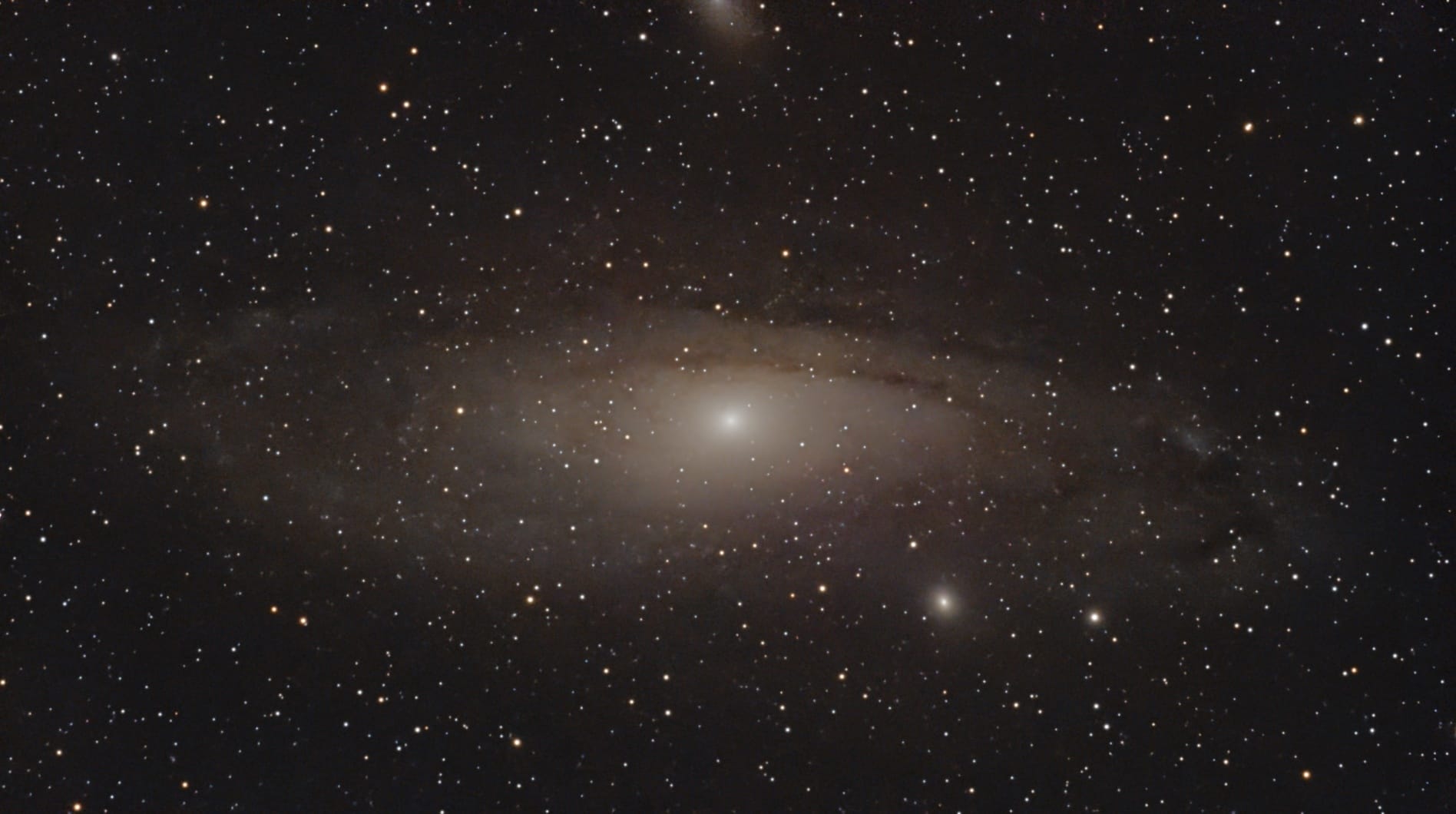
Image details: Captured on the night of 21 September 2026, around 10:17 PM BST, from a London balcony (Bortle ~8-9). Telescope: Dwarf Mini smart scope — 30 mm aperture, 150 mm focal length at f/5, on a tracking alt-az mount. Sensor: Sony IMX662, 2.1 megapixels. The image was stacked and processed in the Dwarf app. Resolution ~1900×1060 pixels. It's a stack of 15 second exposures over about an hour or two if I recall, typical of what the Dwarf Mini can pull off under heavy light pollution. Andromeda's companion elliptical galaxy M110 (NGC 205) is faintly visible below right.
What do we see in this picture
It's a spiral galaxy a lot like our own. My little telescope is not powerful enough to resolve much detail but arguably the whispy white cloudy parts are the most important anyway. Those are mostly stars — yes, stars. Billions of them, in fact about 1 trillion stars (that's 1,000,000,000,000) — the best current estimate as of 2026, making Andromeda about twice as star-rich as the Milky Way. So many stars that my telescope can't even tell them apart; they just look like glowing cloud. The darker banding is interstellar dust, blocking some of that starlight from view.
How to get your head around that many stars. Let's try. Suppose you could count stars at a steady pace, two per second. Two stars, one, two. Two more. At that rate you'd be counting for about 16,000 years before you hit one trillion. Start counting at the birth of the first pyramid and you're still going.
As of 2026, we believe about 1 in 2 stars has at least one planet in orbit around it — conservatively. The Kepler mission transformed our confidence here: planets are not the exception, they are the rule. Most of those planets are almost certainly not habitable, but even a small percentage of a trillion is the biggest number most of us will ever think about.
What else do we know about Andromeda?
Some casual facts.
Distance: About 2.5 million light-years from Earth. That means the light in this picture left Andromeda about the time our early hominid ancestors were first chipping stone tools in the Olduvai Gorge. It is the most distant thing you can see with your naked eye on a dark night.
Size: Roughly 152,000 light-years across — wider than the Milky Way, which clocks in at about 100,000 light-years. If Andromeda were bright enough for its full extent to be visible, it'd be about six times wider than the full Moon in our sky.
Mass: About 1 to 1.5 trillion solar masses, roughly in the same ballpark as the Milky Way. Recent measurements actually suggest our own galaxy may be slightly more massive — the old assumption that Andromeda is clearly bigger has been challenged.
Central black hole: A supermassive black hole called M31* sits at its core, weighing in at about 100–140 million solar masses. That's 25 to 35 times more massive than Sagittarius A* at the centre of the Milky Way. It's relatively quiet — no dramatic feeding going on right now.
Star formation: Andromeda is past its peak. Hubble data from just this year (July 2026) shows its star formation rate has been dropping for half a billion years. Five hundred million years ago it was making about one Sun's worth of new stars per year. Now it's down to about a fifth of a solar mass per year — barely a flicker. Most of what little activity remains is concentrated in a ring about 32,000 light-years from the centre.
Metallicity: Andromeda is generally more metal-poor than the Milky Way, meaning a larger fraction of its stars are older, lower-metallicity populations. Its stellar halo in particular contains a lot of stars stripped from smaller galaxies it has absorbed over the eons — M31 is an aggressive galactic eater.
Satellites: At least 14 known dwarf galaxies orbit Andromeda, most famously M32 and M110 (the fuzzy blob you can see in the picture).
The future: Andromeda is approaching us at about 110 km/s. In about 4.5 billion years, it will collide and merge with the Milky Way. The stars almost certainly won't hit each other — space is mostly empty — but the two galaxies will tangle up into a combined elliptical structure that astronomers have already nicknamed Milkomeda. The Solar System should survive, though nobody knows where it will end up.
What do we not know about Andromeda.
We do not know the name of the dominant civilisation in Andromeda. We do not know the literature of their greatest writers. We don't know how many of their civilisations are AI and how many are biological.
We don't know any of their good jokes.
We don't know how often their greatest astronauts set off on their great journeys, nor how far they travel.
We don't know any of their cool technologies and gadgets.
We've never heard the best music from even one of the many funky planets with the best live shows.
We don't know much. Not yet.
But all those stars...